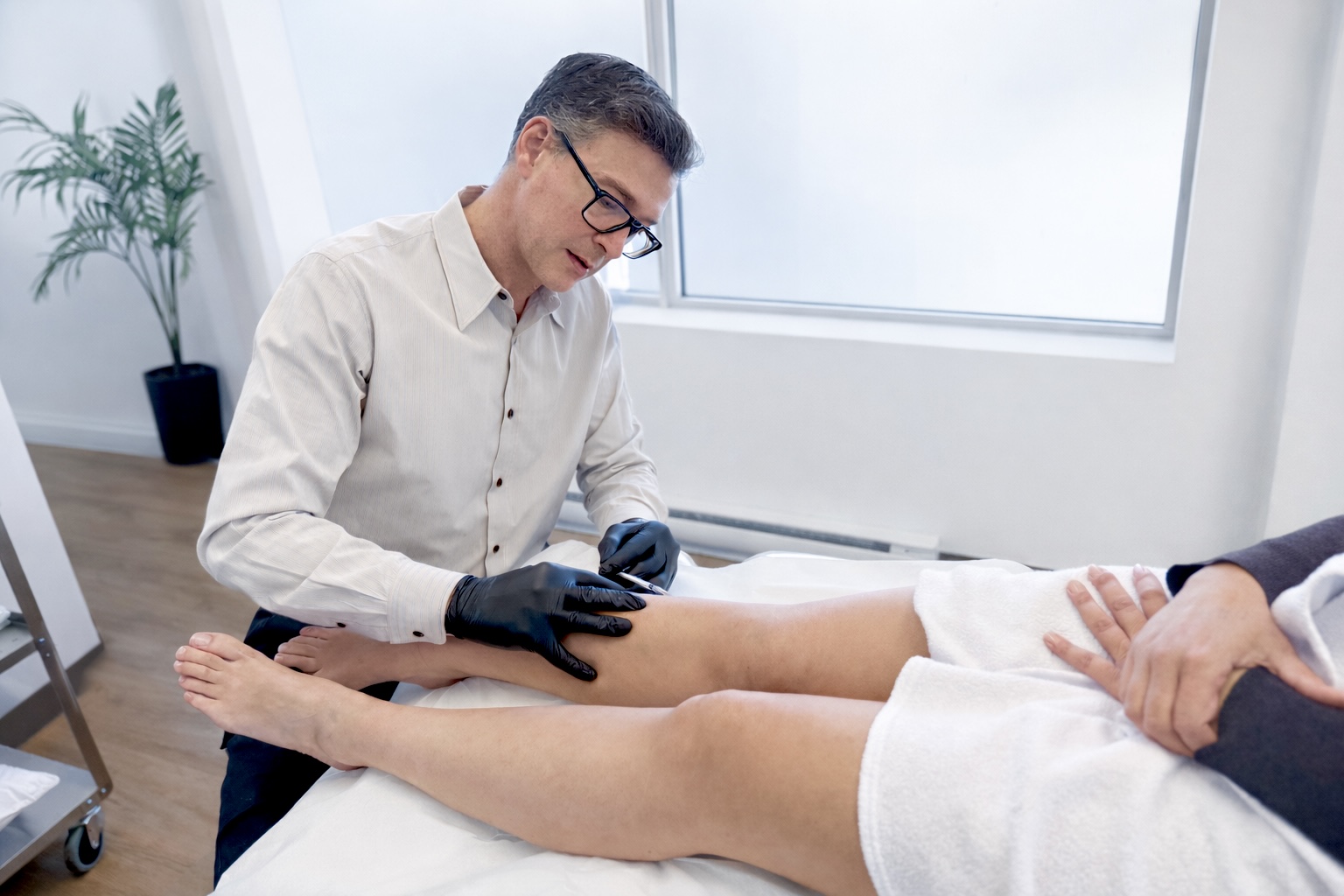
Dr. Dominic St-Amour, a physician specializing in phlebology and Medical Director of Medicart Montréal Clinic, answers our questions.
1- Why do some people have varicose veins while others do not?
The most determining factor is heredity. In both women and men, the risk exceeds 50% if one parent has a severe form of the condition, and it rises to over 80% if both parents are affected. Age also plays a role, primarily because the disease is progressive. Varicose veins can begin appearing as early as age 20, but since venous deterioration develops slowly over time, many people do not seek consultation until their forties.
Another aggravating factor is pregnancy, due to the combined effects of weight gain, hormonal changes, and, from a mechanical standpoint, a possible reduction in venous return. That said, the incidence of varicose veins among women who have never been pregnant is the same as among men.
2- How do varicose veins present themselves?
To use an analogy, our blood circulation system can be compared to a water ecosystem. If a waterway is blocked for one reason or another, the water will overflow elsewhere. While this can be beneficial in some ways, it may also lead to consequences.
Veins are considered varicose when they become dilated and blood no longer circulates properly within them. The spectrum of the disease is very broad, ranging from telangiectasias—small spider veins—to visible “cord-like” veins formed by the saphenous veins, which are larger vessels located just beneath the skin’s surface.
While smaller spider veins are generally more benign, it is important to note that there is no perfectly linear correlation between the size of varicose veins and the severity of symptoms. In other words, very visible varicose veins may cause no heaviness or pain, while seemingly harmless spider veins may be associated with more serious underlying issues.
3 – When should one seek consultation?
As soon as visible veins appear or symptoms such as heavy legs, cramps, swelling, or itching occur. Skin changes—such as dermatitis or even ulcers—are also warning signs that should be closely monitored, as they may indicate a serious condition.
Ongoing annual follow-up is strongly recommended, since even when certain veins are treated, new varicose veins may appear over time, as this is a chronic condition.
4 – What treatments are available?
Depending on their size, progression, and nature, varicose veins can be treated in several ways. The good news is that 90% to 95% of cases that once required surgery can now be treated using non-invasive methods.
Conventional sclerotherapy is the most commonly used approach, especially for spider veins. It involves injecting an irritating medication directly into the vein, causing injury and eventually scarring. As the blood can no longer circulate, the vein will disappear. Typically administered by a nurse under a doctor’s supervision, this treatment may require multiple sessions. Patients can resume their normal activities immediately.
Echo-sclerotherapy can, in certain cases, replace surgery to treat saphenous veins. Injections, performed without anesthesia, are guided by ultrasound and administered by the physician. In the majority of cases, this procedure, which boasts a 95% success rate, requires no recovery time.
Endovenous radiofrequency ablation (Venefit procedure) is reserved for more severe cases. Less invasive than surgery, it’s done under local anesthesia. The procedure involves inserting a catheter into the vein from the knee to the groin and then using radiofrequency to remove it. Treatment duration is approximately one hour, and patients can quickly return to their normal activities. Clinical studies show that this treatment leads to quicker recovery and fewer side effects—such as pain or bruising—than surgery. Additionally, recurrences are less frequent, with a satisfaction rate of 93% after three years.
Endovenous laser treatment is a modern and effective solution for treating varicose veins of the saphenous veins. This technique involves inserting a thin optical fiber into the affected vein to deliver a laser beam. The heat generated causes the vein to close gradually and be naturally absorbed by the body. Performed under local anesthesia, this treatment corrects venous reflux, relieves symptoms such as pain and heaviness, and improves the appearance of the legs, with a rapid return to daily activities.
Microphlebectomy is a procedure used to treat visible superficial varicose veins in the lower limbs. It involves removing varicose veins using a fine needle and hook through very small incisions made under local anesthesia. This technique effectively eliminates veins responsible for pain, heaviness, or discomfort, while leaving minimal scarring. Recovery is quick, and results are both functional and aesthetic.
VenaSeal procedure is a modern approach for treating certain varicose veins and venous diseases. It involves applying a small amount of medical adhesive inside the affected vein to permanently seal it, redirecting blood flow to nearby healthy veins. Performed without general anesthesia, this treatment is generally well tolerated, causes little to no discomfort, and allows for a rapid return to normal activities while effectively relieving symptoms associated with varicose veins.
5 – How are patients managed in the clinic?
We begin with an evaluation, with or without ultrasound imaging, before proposing a treatment plan. In many cases, it is possible to receive treatment during the first visit, particularly for conventional sclerotherapy.
6 – Are treatments covered by RAMQ or private insurance?
These treatments have not been covered by RAMQ since 1984, although patients requiring vascular surgery may undergo the procedure in a hospital setting; however, wait times can be long. Generally, private insurance plans—whose coverage varies—reimburse a significant portion of the initial ultrasound and a small portion of the injectable medication. Compression stockings worn for preventive purposes, particularly during air travel, may also be eligible for reimbursement.
7 – Lastly, how can varicose veins be prevented?
Adopting healthy lifestyle habits such as exercising and controlling weight can have a positive impact. Physical activity—though not necessarily rigorous training—is particularly important. The decrease in movement during the pandemic, spending entire days in front of computers, led to many vein-related symptoms. Actions like getting a coffee, taking the stairs, walking—these movements trigger muscle contractions in the legs, generating a pumping effect to stimulate blood circulation.
Original article – Partner media
This text was originally published in Le Devoir as part of content produced in collaboration with Medicart.